
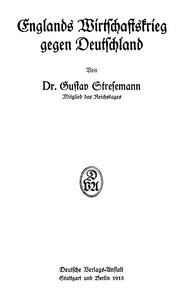
Englands Wirtschaftskrieg gegen Deutschland by Gustav Stresemann
This book isn't a novel, but the story it tells has all the tension of a political thriller. Written in the 1920s by Gustav Stresemann, a key German statesman, it details the harsh economic measures imposed on Germany after World War I. Stresemann goes beyond the well-known issue of reparations payments. He builds a case that England (and its allies) engaged in a sustained campaign using blockades, control of key resources, and financial pressure not just to collect debt, but to systematically weaken Germany's ability to recover and compete.
Why You Should Read It
You get the insider perspective. Stresemann was in the room trying to negotiate relief for his collapsing country. His frustration and strategic analysis leap off the page. It makes the Treaty of Versailles feel less like a historical document and more like a daily crisis. The book forces you to ask big questions: When does legitimate war compensation become a weapon for future conflict? How do economic policies fuel national resentment? Reading this, you can almost feel the ground shifting under Europe in the 1920s, setting the stage for the disaster to come.
Final Verdict
Perfect for history buffs who want to move past simple timelines and understand the 'why' behind the era. If you're interested in economics, international relations, or the roots of World War II, this primary source is incredibly eye-opening. It's a challenging but rewarding read that connects the dots between money, power, and peace in a way that still feels relevant today.
This book is widely considered to be in the public domain. Access is open to everyone around the world.
Karen Williams
1 year agoHonestly, the narrative structure is incredibly compelling. Thanks for sharing this review.
Michelle Thomas
1 year agoCompatible with my e-reader, thanks.
Robert Smith
1 year agoAs someone who reads a lot, it challenges the reader's perspective in an intellectual way. Exceeded all my expectations.
Amanda Thompson
1 year agoThis is one of those stories where the content flows smoothly from one chapter to the next. I learned so much from this.





Noah Harris
3 months agoWithout a doubt, it provides a comprehensive overview perfect for everyone. Exceeded all my expectations.