
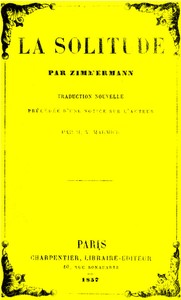
La solitude by Johann Georg Zimmermann
(4 User reviews)
992
Zimmermann, Johann Georg, 1728-1795
French
"La Solitude" by Johann Georg Zimmermann is a philosophical treatise likely written in the late 18th century. The work explores the theme of solitude, discussing its psychological effects and contrasting it with the social obligations and distractions of life. Zimmermann reflects on the tension between the need for social interaction and the deep p...
of the treatise sets the stage for an exploration of solitude, beginning with the author's personal reminiscences of his youth and the joy he found in moments of quiet reflection. It delves into the intrinsic motivations that draw individuals towards solitude, highlighting how societal pressures can lead to an aversion to being alone. Zimmermann emphasizes that solitude is not necessarily a rejection of social ties but rather a necessary escape that allows for deep contemplation and self-discovery. He presents the notion that while society can be alluring, the true satisfaction and tranquility often stem from the solace found within oneself, establishing a meaningful dialogue about the duality of human experience. (This is an automatically generated summary.)
🟢 Public Domain Notice
This historical work is free of copyright protections. Distribute this work to help spread literacy.
Linda Lopez
1 month agoThe layout of the digital version made it easy to start immediately, it manages to maintain a consistent flow even when discussing difficult topics. Simple, effective, and authoritative – what else could you ask for?
William Davis
1 year agoA must-have for graduate-level students in this discipline.
Mary Anderson
5 months agoHaving explored several resources on this, I find that the case studies and practical examples provided add immense value. I’ll definitely be revisiting some of these chapters again soon.
Karen Taylor
3 months agoComparing this to other titles in the same genre, the cross-referencing of different chapters makes it a great study tool. Simple, effective, and authoritative – what else could you ask for?