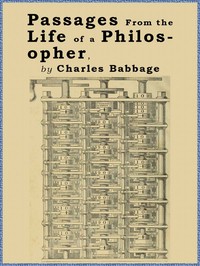
Passages from the Life of a Philosopher by Charles Babbage
The Story
Don’t let the title scare you. This ‘philosopher’ is no mountain-top visionary. Charles Babbage is just a very sharp man sitting in his study, screaming into the void—a void that sounds a lot like 19th-century London fog. The book is his true story: how he designed a steam-powered mechanical computer called the Difference Engine after ‘noble patience’ left him exhausted fixing calculation errors, and then a bigger, bolder version (the Analytical Engine) that could literally read and store data just like your phone—in principle, anyway. The plot includes trying to get money from a suspicious Parliament, hating loud noises in the street, and one epic rivalry with another engineer. It’s part history, part rant, part early TEDx talk, and Babbage’s voice is one part cunning crypt to argue) p with that political, mechanical hullabaloo. There’s even beautiful drama with mice ruining his model. Pure chaos, with math in every misstep.
Why You Should Read It
I wasn’t ready to love this. I thought it would be boring but Babbage spills gossip and ideas no one expects. You get to root for the underdog genius who is unmistakably bitter that every failed demo falls apart; and the text never forgets that he was right. The book slowly makes you feel that despite the dry engine parts, Babbage dreamed of so much: building a machine that could think every music scale if mood he wishes. He talks like you’re lucky to have grabbed a cup of fear-free chat— especially regarding London smog and why it always grows to stinking hellish weather that picks only mathematicians. Its end is happily negative—neither of the grand engines got built in his lifetime—but as technology and humans with stubborn smarts, he wins by us remembering him every time data flows across a wire. That sneaky philosopher gut hooks you before the lecture disguises the climax: A human rebel, not a god-d’s build it himself moment.
Final Verdict
This isn’t a dusty memoir academic no one mentions at parties. It’s a treasure for big dreamers, frustrated creators, puzzle-loving histories—anyone who loves seeing a charming old crank prove how a machine changes everything they sat through for. Perfect for computer nerds and victorian scene architects; safe for a solid 120 pages in e-brain-mode or printed paper. It’s sharp.
This historical work is free of copyright protections. Distribute this work to help spread literacy.