About 87 minutes
The Abbey of St. Albans from 1300 to the dissolution of the monasteries — Story, Setting & Ideas
Middle Ages
19,944 recorded words. 21 minutes difference from this book's estimate.
View Gutenberg source #70381
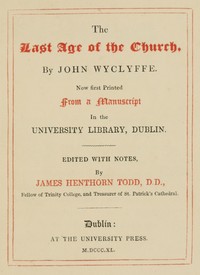
The last age of the church — Text and Context can be approached with a clearer sense of reading commitment from its source measurements: 15,035 words, 1 hr 6 min estimated reading time, and 6 detected text sections.
The text analysis averages about 21.5 words per sentence, while the detected sections provide another way to judge how the source is divided.
Project Gutenberg metadata also associates the work with “Church history -- Middle Ages, 600-1500 -- Sources,” connecting these edition facts with the source record’s subject description.
Explore this collection
These alternatives are selected using recorded categories and estimated reading time.
About 87 minutes
Middle Ages
19,944 recorded words. 21 minutes difference from this book's estimate.
View Gutenberg source #70381About 126 minutes
Middle Ages
28,965 recorded words. 60 minutes difference from this book's estimate.
View Gutenberg source #54250About 134 minutes
Middle Ages
30,816 recorded words. 68 minutes difference from this book's estimate.
View Gutenberg source #19468Search stored excerpts and compare books → Choose by your preferences →
Choices use stored catalog measurements. Estimates vary with reading speed. A shared category is a catalog label, not a claim that two books have the same argument or literary quality.
Search reads excerpt text stored with this catalog and links to its associated Gutenberg record. The connection is stored in the site database; this tool does not recheck that every excerpt is word-for-word identical to that external record. Excerpt search does not cover every chapter and does not verify historical publication dates.
Catalog snapshot checked: 2026-09-25. Coverage: 98 public books, 98 available source excerpts.
Read the complete public-domain text at its original source.
Read on Project GutenbergJohn Wycliffe's 'The Last Age of the Church,' here printed for the first time from a manuscript in the University Library, Dublin, arrives with a preface that immediately questions the adequacy of existing scholarship. Editor James Henthorn Todd cites a popular historian who claims Wycliffe's merits as a reformer have been exaggerated, but Todd counters that the 'original Records' have never been examined with sufficient care. The tract is presented not as a definitive edition, but as a spur to further investigation—a gesture that frames the work as both a primary source and a challenge to future researchers.
Todd's preface is a careful catalog of scholarly debts and disappointments. He notes that Bishop Bale's list of Wycliffe's writings 'has been necessarily made the Basis' for all subsequent work, and he acknowledges the additions by John Lewis and Mr. Baber. But he is pointedly critical of Mr. Vaughan's compilation, which 'has not added much to our Knowledge' and cannot be commended 'for Accuracy or Learning.' Even the more elegant work of Mr. Le Bas, Todd observes, does not profess to do more than follow his predecessors. The cumulative effect is a portrait of a field stalled by reliance on secondary accounts. Todd's solution is direct: 'until the Works of Wyclyffe, real and supposititious, be collected and published, it is vain to talk of determining his Opinions.' The preface thus positions the present tract as a provisional step, not a final word.
The excerpt from the chronicle embedded in Wycliffe's text offers a stark, sensory account of the plague. It describes 'grete Diches and Pyttes' used for mass burial, with bodies layered and covered with 'a lytell Erth.' The passage dwells on the speed of death: 'they that sekened, as on this Daye, dyed on the thyrde Daye after.' It also records a curious biological detail—children born after the pestilence had 'two Cheketethe in ther Heed lesse than they had afore.' Todd's footnotes cross-reference this with Hollinshed and a French chronicle, noting discrepancies in the number of missing teeth. The effect is to show Wycliffe's text as a node in a network of medieval record-keeping, where precise observation mingles with apocalyptic rhetoric.
Todd's editorial apparatus does not merely clarify; it adds a layer of scholarly argument. His footnotes cite multiple chroniclers—Caxton, Hollinshed, William de Nangis—and weigh their accounts against Wycliffe's. For instance, he notes that Hollinshed records a defect of 'four, not two cheke Teeth,' while Wycliffe's source says 'eight grete Teeth.' Todd does not resolve the discrepancy but instead traces it to a French narrative that 'apparently has been the Source from which many of our English Chroniclers have borrowed.' This method turns the edition into a miniature case study in textual transmission. The reader is invited to see Wycliffe's work not as an isolated artifact but as part of a living, contested tradition of historical writing.
Readers approaching this edition should attend to the interplay between Wycliffe's medieval voice and Todd's nineteenth-century editorial frame. The preface's call for a complete collection of Wycliffe's works remains unfulfilled, making this tract a fragment of a larger scholarly project. The chronicle of the plague, with its grim physicality and numerical precision, rewards close reading for what it reveals about medieval habits of observation and record. The footnotes, meanwhile, offer a model of how to read critically across sources.
Reading the editor’s plea to return to Wycliffe’s own words, I recalled my first encounter with the medieval mystics, their patient search for God’s indwelling light. That same quiet ache for immediacy—for a voice unmediated by commentary—comes back here. It is a familiar longing, tender and unresolved, as in Light, Life, and Love: Selections from the German Mystics of the Middle Ages — Reading Notes, where the past feels suddenly, achingly near.
Answer a few questions and save a private reflection on this device.