1

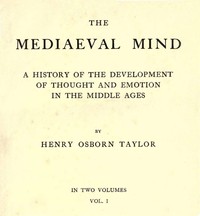
The Mediaeval Mind (Volume 1 of 2) A History of the Development of Thought and Emotion in the Middle Ages — Reading Notes
(0 User reviews)
207
Project Gutenberg
2013
Not confirmed
Civilization, Medieval; Middle Ages; Philosophy, Medieval
Readers of public-domain and historical texts
Project Gutenberg digital edition
en
Edition facts
Words
255,434
Reading time
1111 min
Text sections
38
Before opening The Mediaeval Mind (Volume 1 of 2) A History of the Development of Thought and Emotion in the Middle Ages — Reading Notes, the edition data offers a quick orientation: 255,434 words, 18 hr 31 min estimated reading time, and 38 detected text sections.
The text analysis averages about 17.1 words per sentence, while the detected sections provide another way to judge how the source is divided.
Project Gutenberg metadata also associates the work with “Civilization, Medieval,” connecting these edition facts with the source record’s subject description.
Source:
Project Gutenberg record #43880
This editorial note examines how Henry Osborn Taylor structures his history of medieval thought and emotion through recurring images of movement, ascetic discipline, and the interplay between intellectual argument and spiritual passion, using specific excerpts to trace his method.
Read the complete public-domain text at its original source.
Read on Project GutenbergHenry Osborn Taylor opens The Mediaeval Mind with a striking image: the Middle Ages as a procession, “moved to measures of pulsating and glorifying emotion.” This metaphor of ordered movement—thought marshalling passion—recurs throughout the first volume, shaping how Taylor presents intellectual and spiritual development. Rather than a static survey of doctrines, he builds his narrative around dynamic tensions: between fear and ecstasy, discipline and vision, the cloister and the world. The excerpts reveal a historian attentive to the physical and emotional textures of medieval life, from the calculated blows of a flagellant’s penance to the terror of a corpse’s cry in a conversion legend.
Procession and Pageant: Taylor’s Guiding Metaphor
Taylor’s preface sets the stage with a procession: “Thought marshalled the great mediaeval procession, which moved to measures of pulsating and glorifying emotion.” This is not mere decoration. The metaphor organizes his entire approach, treating ideas as active forces that advance through history in ordered ranks. He invites readers to “press on, through knowledge” and “search out its efficient causes,” as if following a moving column. The image reappears implicitly when he describes the ascetic Dominic “warring” with both hands against the flesh—a miniature procession of discipline. By framing intellectual history as a march, Taylor emphasizes momentum and direction over static classification.
The Body as Battlefield: Ascetic Arithmetic
Taylor dwells on the physicality of medieval piety with clinical precision. He recounts Dominic Loricatus’s penitential calculations: “three thousand blows satisfies a year of penance,” and “chanting ten psalms… admits one thousand blows.” The passage reads like a ledger of suffering, where spiritual debt is repaid in measurable increments. Taylor notes that Dominic “outdid those who struck with only one hand,” highlighting a competitive asceticism. Yet he also observes a psychological twist: “the flesh itself turns morbid and rejoices in its laceration.” This attention to bodily experience—its rhythms, excesses, and paradoxes—grounds abstract theology in tangible, often extreme, practice.
Terror as Turning Point: The Legend of Bruno
Taylor uses the story of Bruno of Cologne to illustrate how fear could catalyze renunciation. The corpse’s three cries—“accusatus sum,” “judicatus sum,” “condemnatus sum”—form a grim crescendo. Taylor notes the tale’s historical improbability but defends its “psychologic truth”: it externalizes the inner dread of damnation. He draws a parallel to Hamlet’s self-consciousness, suggesting that medieval imagination transformed private guilt into public horror. This section exemplifies Taylor’s method: he treats legendary material as evidence of emotional structures, not factual events. The movement from Paris lecture hall to desert cave mirrors the larger trajectory from worldly learning to ascetic flight.
Between Earth and the Invisible: The Landscape of Thought
Taylor characterizes the medieval intellectual terrain as “the land of metaphysical construction and the land of spiritual passion.” He contrasts this with the physical world: “Their terra—not for them incognita, though full of mystery and pall and vaguer glory—was not the earth.” This spatial language recurs in his description of the ascetic’s goal: to “reach the port of salvation.” The movement is always from the visible to the invisible, from the body to the soul. Taylor’s own prose shifts between concrete detail (the blows of a discipline, the cry of a corpse) and abstract commentary, mirroring the medieval oscillation he describes. Readers should attend to how he navigates these registers, as the structure of his argument depends on their interplay.
Taylor’s history rewards attention to its compositional patterns: the recurring metaphors of procession and battle, the careful calibration of physical and spiritual arithmetic, and the use of legend as psychological evidence. These structural choices reveal a historian who sees the Middle Ages not as a distant curiosity but as a world whose inner logic can be traced through its own expressive forms. Readers who follow the movement of Taylor’s argument—from preface to penitential calculus to conversion tale—will find a coherent vision of medieval thought as a dynamic, embodied, and emotionally charged enterprise.
There’s a certain stillness in how Taylor traces the way medieval minds moved between discipline and longing—it stayed with me long after. I found that same quiet pull in View of the State of Europe during the Middle Ages, Vol. 3 — Background and Themes, where the sense of people struggling toward order feels less like history and more like a familiar ache.
There are no reviews for this eBook.
There are no comments for this eBook.
Reader reflection
How will you remember this book?
Save your reaction, strongest insight, and memorable passage.
Your progress
0
/
10
2
Did this book hold your interest?
3
How likely are you to recommend this book?
4
Did the language feel accessible?
5
Did the story or argument move comfortably?
6
Did any part of the book stay with you emotionally?
7
Did it raise ideas you would like to talk about?
8
Would you read this book again?
9
What did this book teach you most?
10