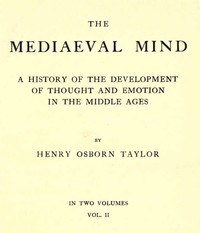
Taylor opens Volume II with a sustained analysis of Heloïse's letters, treating them not as romantic relics but as evidence of a mind shaped by dialectic and conflicting loyalties. He reads her language for signs of a trained intelligence wrestling with passion and religious vocation, noting how her prose oscillates between Ciceronian formality and intimate self-reproach. The chapter establishes a method that governs the whole volume: close attention to the verbal texture of medieval writing as a window onto habits of thought and emotion.
From this personal starting point, Taylor moves outward to broader intellectual structures—symbolism, Latinity, law, and scholastic system-building. His own prose shifts register accordingly, from the sympathetic analysis of individual voices to the exposition of technical philosophical arguments. The reader is invited to watch not only what medieval thinkers believed, but how they wrote and argued, and how those forms constrained or enabled their ideas.
Dialectic and Devotion in Abaelard
Taylor presents Peter Abaelard as a thinker driven by an inescapable need to analyse, even when the subject is divine mystery. He quotes Abaelard's own statement that faith should be fortified by arguments, especially against those who call themselves philosophers. The key tension, for Taylor, lies in Abaelard's identification of the Holy Spirit with the anima mundi—a doctrine that provoked Bernard of Clairvaux's accusation that Abaelard had no mind to believe what his reason had not previously argued.
Taylor does not take sides. Instead, he contrasts two intellectual temperaments: Bernard's conviction that faith does not dispute, and Abaelard's compulsion to ask how he should think a thing declared by revelation. The excerpt shows Taylor's method of letting medieval voices speak in their own terms, then drawing out the underlying conflict. He notes that Abaelard's physical world did not attract his inquiry; the problems that drove him came from self-consciousness and textual authority, not from observation of nature.
Hugo of St. Victor and the Visible World
Where Abaelard ignored the natural world, Hugo of St. Victor found it saturated with meaning. Taylor describes how colours waved before Hugo's reveries and visible sublimities drew his mind aloft to God. For Hugo, all things belonged to one of two categories: the opus conditionis, God's creation of the physical world for human edification, and the opus restaurationis, the incarnation and its sacraments.
Taylor's treatment of Hugo is notably more sympathetic than his account of Abaelard's controversies. He emphasises Hugo's Platonic and Christian theology, his willingness to reason and expound while remaining aware that reason could not reach all the way. The contrast with Abaelard is implicit but sharp: Hugo's mind moved from visible things to invisible, while Abaelard's moved from texts to logical conclusions. Taylor uses this juxtaposition to illustrate the range of twelfth-century intellectual styles, without reducing either to a simple label.
The Architecture of Scholastic Summae
In the later chapters, Taylor turns to the great systematic works of the thirteenth century. He traces the evolution from Abaelard's Theologia—which he notes was more constructively argumentative than his earlier Theologia Christiana—to the massive Summa theologiae of Thomas Aquinas. Taylor points out that Abaelard's threefold division of faith, charity, and sacrament already prefigured the structure Thomas would later perfect.
The excerpt includes a telling detail: Abaelard's definition of faith as existimatio rerum non apparentium, an opinion of things not seen, which Bernard found so objectionable. Taylor does not dwell on the heresy charges; instead, he highlights the methodological continuity. He observes that if Abaelard's work had been completed, its arrangement might have corresponded with Thomas's Summa. The observation is typical of Taylor's approach: he looks for patterns of thought across generations, treating medieval intellectual history as a series of formal experiments in organising knowledge.
Taylor's volume rewards a reader willing to move slowly, attending to the quoted passages and the shifts in his own prose. He is not a neutral summariser; his sympathies emerge in the space he gives to certain thinkers and in the adjectives he chooses. The book is best read as a series of linked essays rather than a continuous narrative. Readers unfamiliar with the primary texts may wish to have Abaelard's Historia Calamitatum and the letters of Heloïse at hand, as Taylor's analysis gains considerably from direct comparison with the originals.
The rain blurred the window as I finished Taylor’s chapter on Abaelard, that restless dialectic. His hunger for reason felt oddly familiar, yet the century’s texture—its damp castles and wool markets—remained shadowy. Afterwards, I picked up Britain in the Middle Ages: A History for Beginners — Themes and Context, almost by accident, and found myself wandering those same grey landscapes, quietly grounded.