
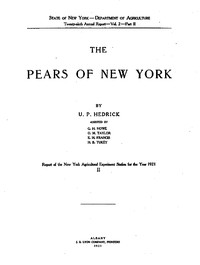
The pears of New York by U. P. Hedrick
Forget what you think you know about boring reference books. 'The Pears of New York' is something else. Published in 1905 by the New York State Department of Agriculture, it's the life's work of botanist U.P. Hedrick. His mission? To find, document, and describe every single variety of pear being grown across New York State.
The Story
There's no traditional plot, but there is a clear narrative drive. Hedrick and his team acted like fruit historians, traveling from farm to farm and orchard to orchard. They were chasing down old, rare, and sometimes nearly extinct pear varieties. The book is their report. For each pear—from the common Bartlett to the forgotten 'Flemish Beauty'—they provide a detailed physical description, notes on its flavor and texture, its history, and, most beautifully, a full-color illustration. The 'story' is the quiet drama of preservation, a snapshot of agricultural diversity right before modern farming changed everything.
Why You Should Read It
You read it for the stunning, almost painterly illustrations of fruit. You read it for the strangely poetic descriptions of taste and texture. But mostly, you read it for the perspective. It makes you see the everyday fruit bowl in a new light. Each pear has a name, a history, and a story of how it got here. It’s a powerful reminder of how much biodiversity we've already lost, wrapped up in a gorgeous, oversized volume. It’s humble, meticulous, and deeply respectful of its subject.
Final Verdict
Perfect for history buffs who enjoy primary sources, gardeners and foodies curious about heirloom varieties, or anyone who appreciates beautiful old books and niche slices of the past. It’s not a page-turner in the usual sense, but as a browsing experience, it’s completely absorbing. Think of it as a museum exhibit you can hold in your hands.
This content is free to share and distribute. Knowledge should be free and accessible.
Logan Anderson
1 year agoSolid story.
David Lewis
2 years agoBased on the summary, I decided to read it and the emotional weight of the story is balanced perfectly. I will read more from this author.
Mark Young
8 months agoLoved it.




Donald Nguyen
1 year agoI was skeptical at first, but the character development leaves a lasting impact. A true masterpiece.