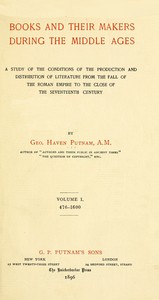
Putnam opens this study by situating the book trade within the economic and legal frameworks of medieval Europe, drawing on university statutes, tax exemptions, and guild regulations. The work moves systematically from the fall of Rome to the close of the seventeenth century, but the first volume concentrates on the manuscript era and the transition to print. A recurring structural pattern is the juxtaposition of institutional rules—such as the requirement that manuscripts be offered for sale for at least four days in a Dominican library—with the practical realities of scribal labor and dealer networks.
Regulatory Frameworks and the Stationarii
Putnam devotes considerable attention to the legal scaffolding that governed manuscript production and sale. In Paris, for instance, booksellers (libraires), parchment dealers (parcheminiers), illuminators (enlumineurs), and scribes (escriipveins) were exempt from the king’s tax, a privilege that signals the trade’s recognized importance for education. The author quotes a regulation specifying these categories, then unpacks the implications: the separate listing of booksellers from scribes indicates a capitalist publishing model, where dealers employed scribes and other workers. A striking detail is the rule that a dealer could not purchase a manuscript left in his hands until it had been offered for sale for at least one month, with the purchaser’s name and price recorded. Such records, Putnam notes, have preserved market values: a fifteenth-century sermon collection sold for 20 Parisian sols, an Ovid text for 6 sols.
Rental Practices and the Pecia System
The university setting introduced a distinctive practice: renting manuscripts rather than selling them outright. Putnam explains that newly prepared transcripts could not be licensed for renting until examined and approved by officials, and their rental prices had to be recorded. The standard rental term was one week, with additional charges for overdue returns. A hirer was required to deposit a pledge, which the stationarius could dispose of after a year. The author contrasts this with the Italian pecia system, where manuscripts were divided into separate quires for simultaneous copying by multiple scribes. Chevillier’s schedule of licensed manuscripts from early thirteenth-century Paris shows only rental rates, with no evidence of pecia division—a structural difference Putnam highlights to distinguish regional practices.
Commission Sales and the Sorbonne Library
Regulations for selling works on commission, renewed in 1300, were so cumbersome that Putnam calls them “peculiarly troublesome.” A sale required two witnesses; no other bookseller could buy the book without the original owner’s permission; and before any sale, the manuscript had to be displayed for at least four days in the Dominican monastery’s library. Exceptions required the rector’s express authority if the owner faced immediate need. These rules, drawn from university archives, illustrate the tension between protecting sellers and facilitating commerce. Putnam also cites an appraisal of the Sorbonne library in 1292, valuing its collection at 3812 livres, 10 sous, 8 deniers—a concrete figure that anchors the discussion of institutional book wealth.
From Manuscript to Market: Evidence of Value
Throughout the volume, Putnam anchors his analysis in specific documentary traces. The requirement to record sale prices yields data points like the 20-sol sermon collection and the 6-sol Ovid. He notes that newly prepared transcripts could not be rented until their prices were registered, and that a stationarius was liable for damages if a university member copied an incorrect manuscript. These details build a picture of a trade where accountability was enforced through written records and institutional oversight. The author’s method is cumulative: each regulation or price notation is set beside others, creating a mosaic of the medieval book economy without claiming completeness.
Putnam’s study rewards readers who attend to the interplay between rule and practice. The excerpts reveal a world where every transaction—sale, rental, commission—was hedged by procedures designed to protect buyers, sellers, and the university alike. Rather than a narrative of progress, the volume offers a cross-section of a trade in flux, where manuscript culture coexisted with the first stirrings of print. For those interested in the material conditions of medieval literature, this work provides a dense, evidence-rich foundation.
Certain books stay with you like old friends, and Books and their makers during the Middle Ages has that quality for me—its careful pages feel almost like touching the hand of a scribe. It made me wonder how quietly faith itself was copied down, which is why I keep The last age of the church — Text and Context nearby now, as a kind of companion to that long, patient dusk.