About 959 minutes
England under the Angevin Kings, Volume II — Themes and Context
Kings Kingdoms
220,543 recorded words. 89 minutes difference from this book's estimate.
View Gutenberg source #68347
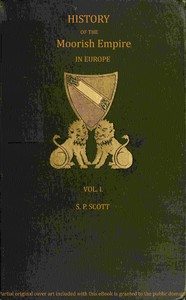
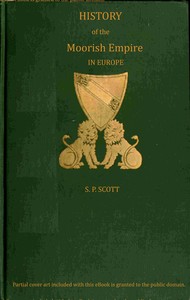
This digital edition of History of the Moorish Empire in Europe, Vol. 1 (of 3) — Text and Context is described by source-level measurements including 240,931 words, 17 hr 28 min estimated reading time, and 30 detected text sections.
The text analysis averages about 28.1 words per sentence, while the detected sections provide another way to judge how the source is divided.
Project Gutenberg metadata also associates the work with “Spain -- History -- 711-1516,” connecting these edition facts with the source record’s subject description.
Explore this collection
These alternatives are selected using recorded categories and estimated reading time.
About 959 minutes
Kings Kingdoms
220,543 recorded words. 89 minutes difference from this book's estimate.
View Gutenberg source #68347About 1,159 minutes
Kings Kingdoms
266,389 recorded words. 111 minutes difference from this book's estimate.
View Gutenberg source #67458About 918 minutes
Kings Kingdoms
211,054 recorded words. 130 minutes difference from this book's estimate.
View Gutenberg source #73492Search stored excerpts and compare books → Choose by your preferences →
Choices use stored catalog measurements. Estimates vary with reading speed. A shared category is a catalog label, not a claim that two books have the same argument or literary quality.
Search reads excerpt text stored with this catalog and links to its associated Gutenberg record. The connection is stored in the site database; this tool does not recheck that every excerpt is word-for-word identical to that external record. Excerpt search does not cover every chapter and does not verify historical publication dates.
Catalog snapshot checked: 2026-09-25. Coverage: 98 public books, 98 available source excerpts.
Read the complete public-domain text at its original source.
Read on Project GutenbergS. P. Scott opens this first volume of a three-part history by positioning his work as a corrective to earlier accounts. He explicitly dismisses Conde's history as unreliable and faults Washington Irving and William H. Prescott for errors, particularly Irving's unfamiliarity with Castilian. Scott's own method, he states, is to present a panorama that includes not only war and diplomacy but also domestic manners, inventions, and literary progress. The preface signals a tension between admiration for Moorish civilization and a moralizing critique of its dynasties.
Scott's treatment of the Ommeyade dynasty in Syria is notably censorious. He describes the Syrian princes as "profligates and infidels" who inherited the "seductive dissipations of the Roman Empire." The court of Damascus, he writes, rivaled "the worst period of imperial degradation," with drunken khalifs requiring slave attendance even in the audience chamber. He details the lavish spending on singing and dancing boys, female performers imported from Mecca, and the universal use of wine despite Koranic prohibition. This moral condemnation is paired with a vivid description of Damascus's opulence: palaces encrusted with porphyry and lapis lazuli, gardens with mosaic walks and perfumed air, and bazaars offering goods from Hindustan to Britain. The contrast between cultural splendor and personal depravity is a recurring pattern in Scott's narrative.
Scott traces the Ommeyades' rise to power from their early opposition to Mohammed. He recounts that Abu-Sofian, a principal sheik of the family, commanded armies against the Prophet at the battle of Ohod, where Mohammed was wounded, and at the siege of Medina. Abu-Sofian's wife Hind is described as a "termagant" who "had torn out and partly devoured the liver of Hamza, Mohammed's uncle" and worn a necklace of ears from fallen Moslems. After Mecca's surrender, Scott notes, the Ommeyades only pretended to conform to Islam "under the threat of instant death." This background frames Scott's portrayal of the dynasty as fundamentally hostile to the faith they later led, a tension that underscores his skepticism about their legitimacy.
Scott's preface outlines his historiographical approach. He aims to depict not just events but the "condition of the masses" and the "policy of the prince." His principal dependence is on the works of R. Dozy, praised for "learning, accuracy, impartiality, and critical acumen." He also cites Arabic and Spanish chronicles, along with Al-Makkari, Romey, and Sédillot. The list of authorities, he notes, does not include all examined works. This methodological statement reveals Scott's ambition to synthesize a wide range of sources while explicitly rejecting earlier historians he deems unreliable. The reader should note that Scott's own moral judgments frequently color his presentation, particularly when describing court life.
Readers approaching this volume should be aware that Scott's narrative is shaped by a dual purpose: to celebrate the intellectual and artistic achievements of Moorish civilization while condemning what he sees as the moral corruption of its rulers. His reliance on Dozy and his critique of Irving and Prescott indicate a desire for scholarly rigor, but his own vivid, often censorious prose invites scrutiny. The excerpts suggest a work that is as much a moral commentary as a historical account.
I keep thinking about how Scott’s first volume framed Moorish brilliance against its own quiet fractures — that ache between what’s built and what’s betrayed. The third book feels like sitting with that same ache longer, watching it echo through later chapters. It stayed with me the way certain sunsets do, unfinished somehow. History of the Moorish Empire in Europe, Vol. 3 (of 3) — Key Ideas to Explore handed me the rest of that feeling.
Your answers remain private and are stored only in this browser.