About 1,033 minutes
Domesday Book and Beyond: Three Essays in the Early History of England — Story, Setting & Ideas
Medieval Society
237,411 recorded words. 62 minutes difference from this book's estimate.
View Gutenberg source #43255
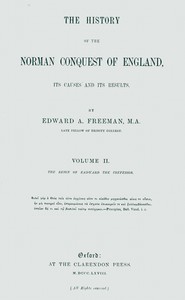
The source record for The history of the Norman conquest of England, its causes and its results, Volume 2 (of 6) — Reading Notes measures this digital text at 251,663 words, 18 hr 15 min estimated reading time, and 50 detected text sections.
The text analysis averages about 20.6 words per sentence, while the detected sections provide another way to judge how the source is divided.
Project Gutenberg metadata also associates the work with “Normans -- England,” connecting these edition facts with the source record’s subject description.
Explore this collection
These alternatives are selected using recorded categories and estimated reading time.
About 1,033 minutes
Medieval Society
237,411 recorded words. 62 minutes difference from this book's estimate.
View Gutenberg source #43255About 924 minutes
Medieval Society
212,444 recorded words. 171 minutes difference from this book's estimate.
View Gutenberg source #73214About 878 minutes
Medieval Society
201,929 recorded words. 217 minutes difference from this book's estimate.
View Gutenberg source #38680Search stored excerpts and compare books → Choose by your preferences →
Choices use stored catalog measurements. Estimates vary with reading speed. A shared category is a catalog label, not a claim that two books have the same argument or literary quality.
Search reads excerpt text stored with this catalog and links to its associated Gutenberg record. The connection is stored in the site database; this tool does not recheck that every excerpt is word-for-word identical to that external record. Excerpt search does not cover every chapter and does not verify historical publication dates.
Catalog snapshot checked: 2026-09-25. Coverage: 98 public books, 98 available source excerpts.
Read the complete public-domain text at its original source.
Read on Project GutenbergFreeman opens this volume by framing the reign of Edward the Confessor as the first stage of a political struggle between Normans and Englishmen, a contest that has not yet erupted into open warfare. The narrative moves between the English court, Norman duchy, and even the papal curia, tracking how Harold and William gradually emerge as leaders of their respective nations. The author’s method is to weave together multiple chronicle accounts, often noting discrepancies—as when he contrasts a “courtly version” of Tostig’s appeal to the Pope with a more plausible account of threats and demands. This attention to source criticism gives the volume a forensic quality, as Freeman weighs evidence to reconstruct motives and events.
Freeman repeatedly returns to the theme that the absence of rulers on pilgrimage created dangerous power vacuums. He notes that the Witan of England wisely prevented Edward from undertaking a pilgrimage, but that Earl Tostig’s journey to Rome in 1061 left Northumberland exposed. During Tostig’s absence, Malcolm of Scotland invaded and ravaged the country, even violating Lindisfarne. Freeman draws a parallel to earlier Norman troubles when Duke Robert went on pilgrimage, and to Harold’s own journey. The pattern is clear: pious journeys, however sincere, invited opportunistic attacks. The author does not condemn pilgrimage outright but emphasizes its political cost, especially for kingdoms without a ruler as formidable as Cnut, who could keep distant nations in check by “the mere terror of his name.”
The account of Tostig and Archbishop Ealdred’s journey to Rome is one of the volume’s most vivid episodes. Freeman describes how the party was attacked by brigands near the Papal States, who stripped them of possessions and nearly captured Tostig. A noble youth named Gospatric saved the earl by claiming to be him, and was released unharmed. The rest returned to the Pope “with nothing but the clothes on their backs.” Freeman presents two versions of how Tostig then secured Ealdred’s pallium: one where the Pope was moved by pity, another where Tostig threatened to withdraw English tribute and expose papal complicity. Freeman judges the threatening account “more of the stamp of truth.” The episode illustrates how even high ecclesiastical business was entangled with banditry, bluff, and the personal authority of earls.
Freeman’s narrative is structured around the careers of the great earls—Godwine, Harold, Tostig—and their fluctuating relationships with the king. The volume shows how Edward’s reign was a period of political jockeying rather than open war. Freeman traces how Harold and William gradually become “leaders and representatives of their several nations” without yet being brought into hostile relations. The author is careful to note when sources conflict, as in the differing accounts of Tostig’s Roman audience. He also highlights the role of the Witan in checking royal power, as when they prevented Edward’s pilgrimage. The volume thus presents a kingdom in which authority was negotiated between king, earls, and churchmen, with no single figure yet dominant.
Freeman’s narrative moves rapidly between settings: the English court, the Norman duchy, the Scottish border, and the roads to Rome. This geographical range underscores the interconnectedness of the period’s politics. A raid in Northumberland is linked to a negotiation at the papal curia; a pilgrimage to Jerusalem affects the security of a distant earldom. Freeman uses these shifts to show how events in one region could have consequences in another, even when the actors were not directly in conflict. The volume’s structure thus mirrors its argument: the Norman Conquest was not a single event but a process that unfolded across multiple theaters, and the reign of Edward the Confessor was the period when the pieces were set in motion.
Readers should approach this volume as a detailed political narrative rather than a military history. Freeman’s strength lies in his critical use of sources and his ability to reconstruct the motives of figures like Tostig and Ealdred. The excerpts suggest a work that rewards careful attention to the author’s asides and source comparisons. Those interested in the mechanics of eleventh-century politics—how earls leveraged papal authority, how pilgrimage destabilized kingdoms, how chroniclers shaped events—will find much to analyze here.
That rainy afternoon, I lost myself in Freeman’s account of Edward the Confessor’s court, the quiet tension between earls and king. His careful tracing of pilgrimages and border raids felt less like history, more like eavesdropping. Later, almost by accident, I picked up The history of England, from the accession of Henry III. to the death of Edward III. (1216-1377) — Story, Setting & Ideas. The same restless crown, a century later, still struggling for footing.
Save your reaction, strongest insight, and memorable passage.