About 407 minutes
Medieval rhetoric and poetic to 1400 — Edition Insights
Medieval Society
93,571 recorded words. 4 minutes difference from this book's estimate.
View Gutenberg source #76844
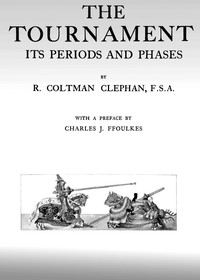
This digital edition of The Tournament—Its Periods and Phases — Reading Notes is described by source-level measurements including 92,588 words, 6 hr 43 min estimated reading time, and 30 detected text sections.
The text analysis averages about 23.6 words per sentence, while the detected sections provide another way to judge how the source is divided.
Project Gutenberg metadata also associates the work with “Military art and science -- History -- Medieval, 500-1500,” connecting these edition facts with the source record’s subject description.
Explore this collection
These alternatives are selected using recorded categories and estimated reading time.
About 407 minutes
Medieval Society
93,571 recorded words. 4 minutes difference from this book's estimate.
View Gutenberg source #76844About 375 minutes
Medieval Society
86,114 recorded words. 28 minutes difference from this book's estimate.
View Gutenberg source #13144About 375 minutes
Medieval Society
86,047 recorded words. 28 minutes difference from this book's estimate.
View Gutenberg source #63913Search stored excerpts and compare books → Choose by your preferences →
Choices use stored catalog measurements. Estimates vary with reading speed. A shared category is a catalog label, not a claim that two books have the same argument or literary quality.
Search reads excerpt text stored with this catalog and links to its associated Gutenberg record. The connection is stored in the site database; this tool does not recheck that every excerpt is word-for-word identical to that external record. Excerpt search does not cover every chapter and does not verify historical publication dates.
Catalog snapshot checked: 2026-09-25. Coverage: 98 public books, 98 available source excerpts.
Read the complete public-domain text at its original source.
Read on Project GutenbergClephan's study of the tournament is distinguished by its insistence on the physical realities of armour and equipment. The preface notes that Henry VIII's foot-combat suit weighs 93 lbs., and a sixteenth-century jousting horse carried a dead weight of 340 lbs., making the 'dash and intrepid onslaught' described by chroniclers physically improbable. This tension between literary romance and material constraint runs through the work.
The book draws extensively on German tourney-books and the Freydal, making available material previously inaccessible to English readers. Clephan's focus is not on narrative pageantry but on the precise mechanics of courses like the Scharfrennen, where the objective was unhorsing, and the saddle was designed accordingly.
Clephan repeatedly uses specific weights and measurements to ground tournament practice in physical reality. The preface highlights that Henry VIII's foot-combat armour weighs 93 lbs., and a jousting horse carried 340 lbs. of dead weight. These figures challenge romantic depictions of knights charging at full gallop. The author notes that the horse 'could only amble gently along the tilt,' contradicting artistic conventions. This approach extends to the armour itself: the jousting-salade (Rennhut) is forged in one piece, with reinforcing plates over the temples (Stirnplätter) and a thick abdominal plate (Magenblech). The weight and rigidity of such equipment directly shaped the pace and danger of the contest.
Clephan distinguishes several tournament forms, each with specific rules and equipment. In the Scharfrennen (or Schweifrennen), the primary goal was unhorsing, though splintering lances also counted in scoring. The jouster who 'sat his horse the longest against the greatest number of splintered lances' was declared victor. The lance was aimed at the opponent's beaver or jousting-shield; hitting the beaver was more difficult but often decisive. The saddle was smaller and lighter than in other courses, weighing just over four kilos, with a low pommel and no cantle—shaped much like a modern British saddle. This design facilitated unhorsing, as the rider had less support. The armour was also lighter, with a shorter back-plate and no motons over the armpits, relying instead on a large vamplate for protection.
The tournament evolved differently across Europe. Clephan emphasises German practices, drawing on sources like the Saxon tourney-books and Freydal. In Germany, the Scharfrennen remained popular into the sixteenth century, while in England, France, and Italy, the joust at the tilt became dominant. The preface notes that by the late sixteenth century, tournaments had become 'a rather dull performance' due to minute regulations and cumbersome equipment. Even Henry VIII's displays are described as predictable: the king invariably won, and the queen could stop the tilting 'when her lord had had sufficient entertainment.' This contrast between earlier, more dangerous contests and later ceremonial forms is a recurring theme, supported by evidence of changing armour weights and saddle designs.
Clephan's work rewards readers who attend to the technical details—the weights, measurements, and material constraints that shaped tournament practice. The book does not offer a romanticised view but a forensic one, grounded in surviving armour, contemporary illustrations, and German-language sources. For those interested in the gap between literary ideal and physical reality, this study provides a wealth of specific, evidence-based observations.
Flipping through The Tournament—Its Periods and Phases, I lingered on how the armored clang fades into pageantry, how rules tighten until the fight becomes a ritual. That softening reminded me of a quieter chronicle I’ve kept nearby, where battles are already memory, noted with careful distance. The chronicles of Enguerrand de Monstrelet, Vol. 02 [of 13] — Key Ideas to Explore feels like that same sunset hour, facts preserved before the color fully drains.
Build a private reading journal entry for this title.