About 512 minutes
The History of Chivalry — Context and Discussion
Crusades
117,725 recorded words. 33 minutes difference from this book's estimate.
View Gutenberg source #40537
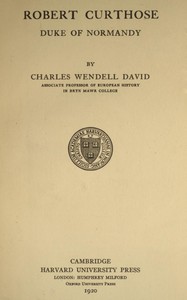
Robert Curthose, Duke of Normandy — Story, Setting & Ideas can be approached with a clearer sense of reading commitment from its source measurements: 109,956 words, 7 hr 59 min estimated reading time, and 17 detected text sections.
The text analysis averages about 15.6 words per sentence, while the detected sections provide another way to judge how the source is divided.
Project Gutenberg metadata also associates the work with “Crusades -- First, 1096-1099,” connecting these edition facts with the source record’s subject description.
Explore this collection
These alternatives are selected using recorded categories and estimated reading time.
About 512 minutes
Crusades
117,725 recorded words. 33 minutes difference from this book's estimate.
View Gutenberg source #40537About 445 minutes
Crusades
102,135 recorded words. 34 minutes difference from this book's estimate.
View Gutenberg source #72852About 394 minutes
Crusades
90,543 recorded words. 85 minutes difference from this book's estimate.
View Gutenberg source #4370Search stored excerpts and compare books → Choose by your preferences →
Choices use stored catalog measurements. Estimates vary with reading speed. A shared category is a catalog label, not a claim that two books have the same argument or literary quality.
Search reads excerpt text stored with this catalog and links to its associated Gutenberg record. The connection is stored in the site database; this tool does not recheck that every excerpt is word-for-word identical to that external record. Excerpt search does not cover every chapter and does not verify historical publication dates.
Catalog snapshot checked: 2026-09-25. Coverage: 98 public books, 98 available source excerpts.
Read the complete public-domain text at its original source.
Read on Project GutenbergCharles Wendell David's study of Robert Curthose, Duke of Normandy, opens with a dense apparatus of footnotes that immediately signals its scholarly method: the author weighs conflicting accounts from Ordericus Vitalis, William of Malmesbury, Eadmer, and the Anglo-Saxon Chronicle. The excerpts show David repeatedly adjudicating between sources, as when he rejects Ordericus's romanticized version of the 1101 peace negotiations between Robert and Henry I, calling it 'essentially untrustworthy' because it contradicts English chroniclers. This critical posture defines the work's approach to a figure often dismissed as a failed crusader and ineffectual ruler.
The excerpts reveal David's primary method: juxtaposing medieval accounts to expose their biases. For the invasion of 1101, Ordericus describes a chivalric scene where the brothers meet 'remotis omnibus arbitris,' exchanging 'sweet kisses,' while English sources like Eadmer portray Robert as deterred by the threat of excommunication and the loyalty of English subjects. David notes that Ordericus's noble envoys 'turned out to be base traitors, who desired war rather than peace,' a detail absent from other records. The author does not simply harmonize these versions; he declares one unreliable, citing Ordericus's 'fundamental disagreement' with the English tradition. This forensic approach extends to small details: Wace's chivalric anecdote about Robert refusing to attack Queen Matilda in childbed is checked against Ramsay's chronology, which shows the child was not yet born. David treats even picturesque stories as evidence to be tested.
Rather than offering direct psychological portraits, David lets actions and contemporary judgments speak. William of Malmesbury's assessment is quoted: Robert 'trusted more in the perfidy of others than in his own industry.' The duke's decision to abandon battle at Alton is presented through multiple lenses—Eadmer mentions Anselm's threat of excommunication, while Ordericus blames treacherous intermediaries. David's own voice emerges in footnotes that weigh probabilities, as when he dismisses Freeman's attempt to reconcile the accounts. The reader sees a leader who 'destitit praelio, descivit a negotio' (withdrew from battle, desisted from the enterprise), a pattern that the sources attribute variously to piety, prudence, or weakness. David does not resolve the ambiguity but instead highlights how each chronicler shaped Robert's image to serve their narrative—Ordericus favoring Norman honor, English writers emphasizing Anselm's authority and Henry's legitimacy.
The text is embedded in a thick web of citation: the excerpts alone reference Ordericus, Florence of Worcester, Henry of Huntingdon, Eadmer, William of Malmesbury, Wace, and the Anglo-Saxon Chronicle, often with multiple page numbers per note. David engages with modern historians like Freeman and Ramsay, correcting or rejecting their interpretations. The footnotes sometimes run longer than the main text, as in the extended discussion of the 1101 peace negotiations. This apparatus serves a dual purpose: it demonstrates the evidentiary basis for each claim and reveals the gaps and contradictions in the record. For readers accustomed to narrative history, the density of citation may feel obstructive, but it is integral to David's project of reconstructing Robert's career from fragmentary, partisan sources. The work is as much about the craft of historical writing as about its ostensible subject.
Readers should approach this biography as a case study in source criticism rather than a straightforward life story. David's meticulous footnoting rewards those who follow the arguments into the apparatus, where the real drama of conflicting evidence plays out. The book assumes familiarity with Norman and Anglo-Norman history; newcomers may benefit from first consulting a general account of the period. Pay particular attention to how David handles Ordericus—his most colorful source and his most suspect.
Sometimes, shelving Robert Curthose beside Vahram's chronicle of the Armenian kingdom in Cilicia, during the time of the Crusades. — Reading Companion, I think of how both men watched their fathers’ certainties crumble. One duke, one chronicler—each left standing at history’s edge, holding a frayed thread of legacy. Quietly, they share that loneliness of being remembered only sideways.
Save your reaction, strongest insight, and memorable passage.