About 932 minutes
The History of the Crusades (vol. 1 of 3) — Context and Discussion
Crusades
214,196 recorded words. 98 minutes difference from this book's estimate.
View Gutenberg source #49104
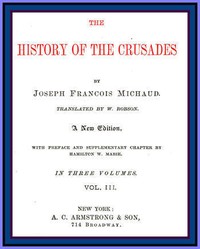
Before opening The History of the Crusades (vol. 3 of 3) — Inside the Classic, the edition data offers a quick orientation: 236,854 words, 17 hr 10 min estimated reading time, and 34 detected text sections.
The text analysis averages about 22.3 words per sentence, while the detected sections provide another way to judge how the source is divided.
Project Gutenberg metadata also associates the work with “Crusades,” connecting these edition facts with the source record’s subject description.
Explore this collection
These alternatives are selected using recorded categories and estimated reading time.
About 932 minutes
Crusades
214,196 recorded words. 98 minutes difference from this book's estimate.
View Gutenberg source #49104About 888 minutes
Crusades
204,068 recorded words. 142 minutes difference from this book's estimate.
View Gutenberg source #49118About 696 minutes
Crusades
159,974 recorded words. 334 minutes difference from this book's estimate.
View Gutenberg source #39701Search stored excerpts and compare books → Choose by your preferences →
Choices use stored catalog measurements. Estimates vary with reading speed. A shared category is a catalog label, not a claim that two books have the same argument or literary quality.
Search reads excerpt text stored with this catalog and links to its associated Gutenberg record. The connection is stored in the site database; this tool does not recheck that every excerpt is word-for-word identical to that external record. Excerpt search does not cover every chapter and does not verify historical publication dates.
Catalog snapshot checked: 2026-09-25. Coverage: 98 public books, 98 available source excerpts.
Read the complete public-domain text at its original source.
Read on Project GutenbergMichaud opens this volume with the Eighth Crusade, detailing the fortification of Christian cities in Palestine by Louis IX and the internal quarrels among Crusaders. The narrative quickly shifts to the complex power struggles among Saracens, including the assassinations of Sultan Aibek and Sultana Chegger-Adour, and the rise of the Mamelukes under Bibars. The author interweaves the Mongol threat, capturing Bagdad and Syrian cities, with the Christian response, creating a multi-front conflict.
Notably, Michaud pauses the military chronicle to examine the nature of medieval justice, contrasting personal revenge with the Church's penitential system. He argues that the Crusades temporarily quelled private wars, as Europe fell silent before the cross. This structural alternation between battle narrative and institutional analysis characterizes the volume.
Michaud traces the Mameluke seizure of power in Egypt, from the assassination of Koutouz to Bibars' proclamation as sultan. Bibars immediately declares war on the Christians of Palestine, defeating and expelling the Tartars before turning on Crusader strongholds. The sieges of Cæsarea, Arsouf, and Sefed are described with a focus on slaughter and devastation. The capture and destruction of Antioch, despite Bohemond's treaty with Bibars, marks a turning point. Michaud notes the slaughter of inhabitants, emphasizing the fragility of Crusader diplomacy. The narrative relies on a sequence of sieges and betrayals, showing how military momentum shifts irreversibly to the Mamelukes.
In a reflective passage, Michaud argues that medieval barons felt injustice only as a wound in battle, making revenge a duty. He describes private wars as an habitual state with its own jurisprudence, where fields were ravaged and towns burned. The Church attempted to counterbalance this violence through religious authority, invoking saints, visions, and the Truce of God—suppressing warfare on certain days. Michaud contends that the Crusades wonderfully seconded the clergy, as discords were appeased when war was declared against Saracens. This section uses legal and moral vocabulary, contrasting civil justice with the tribunal of penitence, which judged the guilty through remorse and fear of hell.
Michaud examines how the Church's penitential system extended its influence into civil affairs. He writes that people believed God pronounced judgments through his ministers, leading popes to claim jurisdiction over princes' policies by deeming them sins. The author notes that the clergy usurped judicial authority, a development he treats with ambivalence. This analysis is grounded in the specific example of papal interference in the royal family of Swabia and the crowning of Charles of Anjou as king of Sicily. Michaud does not endorse or condemn but presents the institutional logic: a tribunal so formidable necessarily increased clerical power, even in matters where evangelical morality was not interested.
Louis IX determines upon a fresh crusade, with support from James of Arragon and Edward of England, but Joinville declines. The Crusaders arrive at Tunis, where Michaud inserts a historical notice of the region. The campaign falters due to Muslim resistance and sickness among the Crusaders, culminating in Louis's death. The author's treatment is terse, focusing on the logistical and epidemiological failures rather than heroism. This section closes the military narrative, leaving the Crusader project in disarray. Michaud's structure here mirrors earlier volumes: a grand expedition, internal dissent, and an anticlimactic end, reinforcing his cyclical view of Crusader history.
Readers should attend to Michaud's method of alternating between event-driven chronicle and thematic essays. The volume's strength lies in its willingness to step back from battles to examine the social and legal structures that shaped Crusader society. The excerpts suggest a historian more interested in institutional change than in military glory. For those following the full three-volume work, this final installment completes the arc from enthusiasm to exhaustion, ending not with triumph but with the sobering rise of Mameluke power and the Church's expanding temporal authority.
I finished that third volume feeling the weight of endings—how the heat and dust of those final campaigns just seemed to settle, quietly, into history's long shadow. It reminded me of sitting with The Story of the Crusades — Background and Themes afterward, not to finish but to sit with it, letting the quieter threads, like the Truce of God, linger a little longer in my chest.
Save your reaction, strongest insight, and memorable passage.