About 105 minutes
Stories from the Crusades — Inside the Classic
Crusades
24,147 recorded words. 10 minutes difference from this book's estimate.
View Gutenberg source #67761
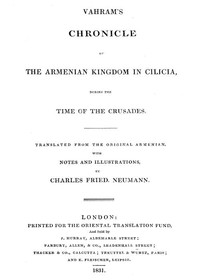
The catalog record for Vahram's chronicle of the Armenian kingdom in Cilicia, during the time of the Crusades. — Reading Companion provides practical reading context through 21,791 words, 1 hr 35 min estimated reading time, and 3 detected text sections.
The text analysis averages about 22.0 words per sentence, while the detected sections provide another way to judge how the source is divided.
Project Gutenberg metadata also associates the work with “Armenians -- Turkey -- Cilicia -- History -- Early works to 1800,” connecting these edition facts with the source record’s subject description.
Explore this collection
These alternatives are selected using recorded categories and estimated reading time.
About 105 minutes
Crusades
24,147 recorded words. 10 minutes difference from this book's estimate.
View Gutenberg source #67761About 195 minutes
Crusades
44,629 recorded words. 100 minutes difference from this book's estimate.
View Gutenberg source #50791About 248 minutes
Crusades
56,925 recorded words. 153 minutes difference from this book's estimate.
View Gutenberg source #6032Search stored excerpts and compare books → Choose by your preferences →
Choices use stored catalog measurements. Estimates vary with reading speed. A shared category is a catalog label, not a claim that two books have the same argument or literary quality.
Search reads excerpt text stored with this catalog and links to its associated Gutenberg record. The connection is stored in the site database; this tool does not recheck that every excerpt is word-for-word identical to that external record. Excerpt search does not cover every chapter and does not verify historical publication dates.
Catalog snapshot checked: 2026-09-25. Coverage: 98 public books, 98 available source excerpts.
Read the complete public-domain text at its original source.
Read on Project GutenbergNeumann's preface frankly acknowledges the chronicle's limitations: Vahram, a priest and secretary to King Leon III, 'relates many barren facts, without stating the circumstances with which they were connected' and 'mistakes every where the passions of men for the finger of God.' Yet the translator argues that this contemporary record is valuable precisely because it fills a gap in Western historiography. Gibbon, Neumann notes, merely mentions Cilicia, overlooking a kingdom that 'carried on successful wars against the emperors of Constantinople' and remained a Frankish ally throughout the Crusades.
The volume's extensive footnotes—far longer than the chronicle itself—reveal the editor's preoccupations: tracing Armenian origins to the Assyrians, correcting Strabo's conflation of Armenians with Syrians, and documenting commercial treaties with Venice and Genoa. These notes often overshadow Vahram's own narrative, making the book as much a nineteenth-century scholarly apparatus as a medieval source.
Neumann's preface sets the tone for the entire volume by cataloging Vahram's shortcomings as a historian. The chronicler 'exhibits almost all the faults of the common Chroniclers of the Middle Ages,' including a tendency to present disconnected facts and to interpret events through divine intervention. Yet Neumann insists that the work is 'valuable' precisely because it is contemporary—Vahram wrote as secretary to King Leon III, placing him at the center of Cilician Armenian politics during the Crusader period.
The excerpts show that Neumann's own notes often compensate for Vahram's brevity. For instance, where Vahram merely mentions the flight of Rouben in 1080, Neumann provides a footnote explaining that this event marks the beginning of the Cilician Armenian kingdom. Similarly, when Vahram refers to the Taurus mountains, Neumann quotes Colonel Leake's description of 'ancient catacombs' as evidence of earlier habitation. The reader thus encounters two texts: Vahram's spare narrative and Neumann's dense commentary, which together create a layered historical document.
Neumann's footnotes dominate the volume, often exceeding the chronicle in length and detail. They reveal a nineteenth-century Orientalist's preoccupations: establishing Armenian origins, correcting classical geographers, and documenting commercial ties. Note (14), for example, argues that Armenians are 'a tribe of the ancient Assyrians' based on linguistic evidence, while dismissing Strabo's claim that Armenians and Syrians are the same people as 'quite wrong.' Note (15) provides a brief history of the Bakratounian kings, and Note (16) explains that Armenia was a 'feudal monarchy' from Parthian times, justifying the use of feudal terminology.
The editor also includes references to contemporary scholarship, such as Saint-Martin's Mémoires sur l’Arménie and Col. Leake's travels. These notes serve a dual purpose: they contextualize Vahram's chronicle for a European audience unfamiliar with Armenian history, and they assert Neumann's own authority as a scholar. The result is a work that is as much about the editor's erudition as it is about Vahram's narrative.
Despite the chronicle's brevity, the excerpts hint at Cilicia's strategic position between Byzantine, Crusader, and Muslim powers. Neumann's preface notes that the Crusaders were 'astonished to find within the frontiers of the Byzantine empire a powerful prince and ally of whom they had never before heard mention.' This observation underscores the kingdom's relative obscurity in Western sources, which the chronicle aims to remedy.
The footnotes also reveal Cilicia's commercial importance: the Venetians and Genoese 'made several commercial treaties with the Armenian kings,' and Neumann prints one such agreement in the original Armenian with translation. The editor's note (18) traces Cilicia's coastline to the 'gulph of Issus or Scanderum,' linking it to ancient trade routes. These details suggest that Vahram's chronicle, though focused on political and military events, opens a window onto a kingdom that was both a Crusader ally and a commercial hub.
Readers approaching this volume should be prepared for a work that is as much about its translator as its author. Neumann's editorial voice is ever-present, shaping the chronicle through selection, annotation, and critique. The value of Vahram's text lies not in its literary merit or historical completeness, but in its survival as a contemporary witness to a kingdom that European historiography largely ignored. To appreciate the chronicle, one must read it alongside Neumann's apparatus, attending to the gaps and tensions between the medieval source and its modern editor.
There’s something tender about Vahram’s clipped record of Cilician Armenia—so much left unsaid between his lines. Reading him, I felt the same ache that Memoirs or Chronicle of the Fourth Crusade and the Conquest of Constantinople — Reading Companion stirs: empires remembered obliquely, through half-faded loyalties and quiet grief.
Save your reaction, strongest insight, and memorable passage.