About 95 minutes
Vahram's chronicle of the Armenian kingdom in Cilicia, during the time of the Crusades. — Reading Companion
Crusades
21,791 recorded words. 10 minutes difference from this book's estimate.
View Gutenberg source #60171
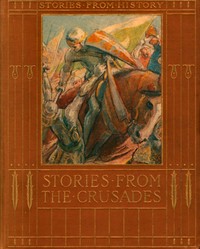
Stories from the Crusades — Inside the Classic can be approached with a clearer sense of reading commitment from its source measurements: 24,147 words, 1 hr 45 min estimated reading time, and 13 detected text sections.
The text analysis averages about 17.5 words per sentence, while the detected sections provide another way to judge how the source is divided.
Project Gutenberg metadata also associates the work with “Crusades -- Juvenile literature,” connecting these edition facts with the source record’s subject description.
Explore this collection
These alternatives are selected using recorded categories and estimated reading time.
About 95 minutes
Crusades
21,791 recorded words. 10 minutes difference from this book's estimate.
View Gutenberg source #60171About 195 minutes
Crusades
44,629 recorded words. 90 minutes difference from this book's estimate.
View Gutenberg source #50791About 248 minutes
Crusades
56,925 recorded words. 143 minutes difference from this book's estimate.
View Gutenberg source #6032Search stored excerpts and compare books → Choose by your preferences →
Choices use stored catalog measurements. Estimates vary with reading speed. A shared category is a catalog label, not a claim that two books have the same argument or literary quality.
Search reads excerpt text stored with this catalog and links to its associated Gutenberg record. The connection is stored in the site database; this tool does not recheck that every excerpt is word-for-word identical to that external record. Excerpt search does not cover every chapter and does not verify historical publication dates.
Catalog snapshot checked: 2026-09-25. Coverage: 98 public books, 98 available source excerpts.
Read the complete public-domain text at its original source.
Read on Project GutenbergJanet Harvey Kelman’s Stories from the Crusades opens not with a battle but with a restless boy in a quiet castle. The first chapter introduces Peter the Hermit through his childhood longing for a wider world, a pattern of waiting and departure that recurs across the five tales. Kelman frames the Crusades as a collision between a “beautiful dream” and the selfish motives of men like Bohemond and Baldwin, a tension she sustains through repeated images of halted movement—kings delayed by storms, armies stalled before Acre, and the legendary Barbarossa sleeping in an undiscovered castle.
Each story begins with a figure poised between stasis and action. Peter the Hermit is introduced as a boy who “liked always to do or to hear something new” but is confined to a “very quiet” home. The narrative then shifts abruptly to his adult preaching, skipping the transition. Similarly, Barbarossa’s tale ends with the emperor imprisoned in a castle, waiting “until his country needs him.” The crusading kings Philip and Richard “were stayed by a storm” on an island, losing time and friendship. These pauses create a rhythm of anticipation that Kelman uses to underline the gap between crusading ideals and human frailty.
Kelman repeatedly describes the physical layout of camps and sieges to dramatize the crusaders’ predicament. At Acre, the Christian camp “lay round the landward walls of the city,” but beyond it stretched the Moslem camp, so that an attack on the city left the tents vulnerable. This spatial trap mirrors the moral one: the knights are caught between their vows and their quarrels. The text notes that during lulls, “warriors from the Moslem camp and the crusading knights held tournaments and dances in the open spaces between the tents.” These interstitial zones—neither camp nor city—become stages for strange friendships and forgotten goals.
Kelman weaves bodily details into her narrative of faith and failure. The crusaders believe that since the loss of the True Cross, babies have had “only twenty-two teeth instead of thirty-two.” This peculiar physiological claim is presented without irony, as one of the “queer things” people believed. Later, Richard’s anger at delayed ransom leads him to “slay five thousand prisoners,” a mass killing that contrasts with the earlier focus on relics. The body of Barbarossa, too, is imagined as a dormant presence: “no one has seen the red glow of Barbarossa’s beard in the dimly lighted hall.” These images tie the abstract cause of the Crusades to tangible, often grotesque, human forms.
Kelman emphasizes how quickly crusader solidarity dissolves. Richard and Philip, once friends, “quarrelled so fiercely” that their deeds were “marred by bitter hatred.” During peace, both kings “were more friendly with Saladin than they were with each other,” accepting food and doctors from him while suspecting each other of poison. Saladin himself rides into battle “with the badge of chivalry on his breast,” a detail that blurs the line between enemy and ally. The common soldiers, Kelman writes, “did not know what to think,” as their masters seemed more eager to exchange gifts with Moslem leaders than to take Jerusalem. This confusion is the emotional core of the narrative.
Kelman’s stories are best read as a series of moral tableaux rather than a continuous history. The reader should attend to the spaces between events—the waiting, the encampments, the uneasy truces—where the author’s commentary on human ambition and idealism emerges most clearly. The illustrations by L. D. Luard, listed in the contents, likely reinforce these contrasts between stillness and action.
That waiting in Kelman’s stories—the stillness between camps—stayed with me long after I closed the book. It felt less like history and more like a shared, quiet ache. I found that same unhurried ache in The History of the Crusades (vol. 3 of 3) — Inside the Classic, where dreams and selfishness settle into the same shadow, and I kept thinking about it days later.
Answer a few questions and save a private reflection on this device.